REVIEW: Happy Days, with AutoBody Theater.

Watching a Samuel Beckett play often feels like experiencing an apocalypse in real time. His characters exist in desolate landscapes, practically carrying the weight of the world on their shoulders, and by the play's end, we bear witness to whether they give in to that weight, or if they somehow find the strength in themselves to keep standing. For all that is dour and grim about Beckett's work, there's always something hopeful hidden inside them, a belief that on the other side of apocalypse is perhaps something better. When the earth consumes us, greener pastures await. One must imagine Didi and Gogo happy.
Perhaps the only thing staving off our own personal apocalypse, then, is the continued presence of Samuel Beckett in our lives, a reminder of the outsized, absurd possibilities of the theatrical medium. With that, it's always a happy day when a new Beckett production pops up in Chicago, and so it is with this new staging of Happy Days, being produced at the Neo-Futurist Theater by AutoBody Theater, the self-professed "home base" for the directorial efforts of former Neo's ensemble member Trent Lunsford. For those uninitiated into the rhythms and eccentricities of Beckett, or for those whose knowledge goes only as far as Waiting for Godot, Lunsford's Happy Days is as welcome an introduction as any, a finely crafted and ably performed paean to why Beckett has yet to be surpassed as our finest absurdist.
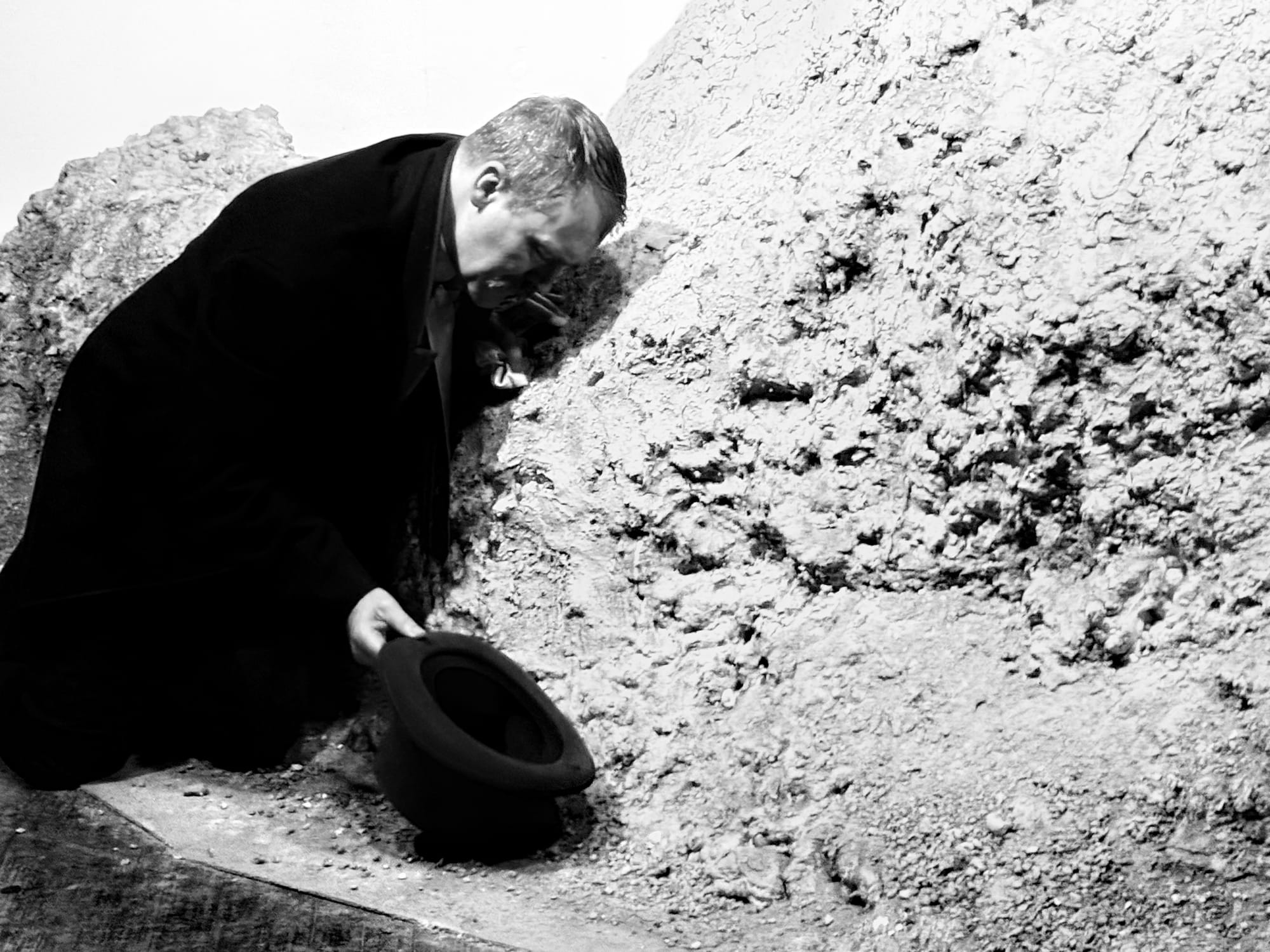
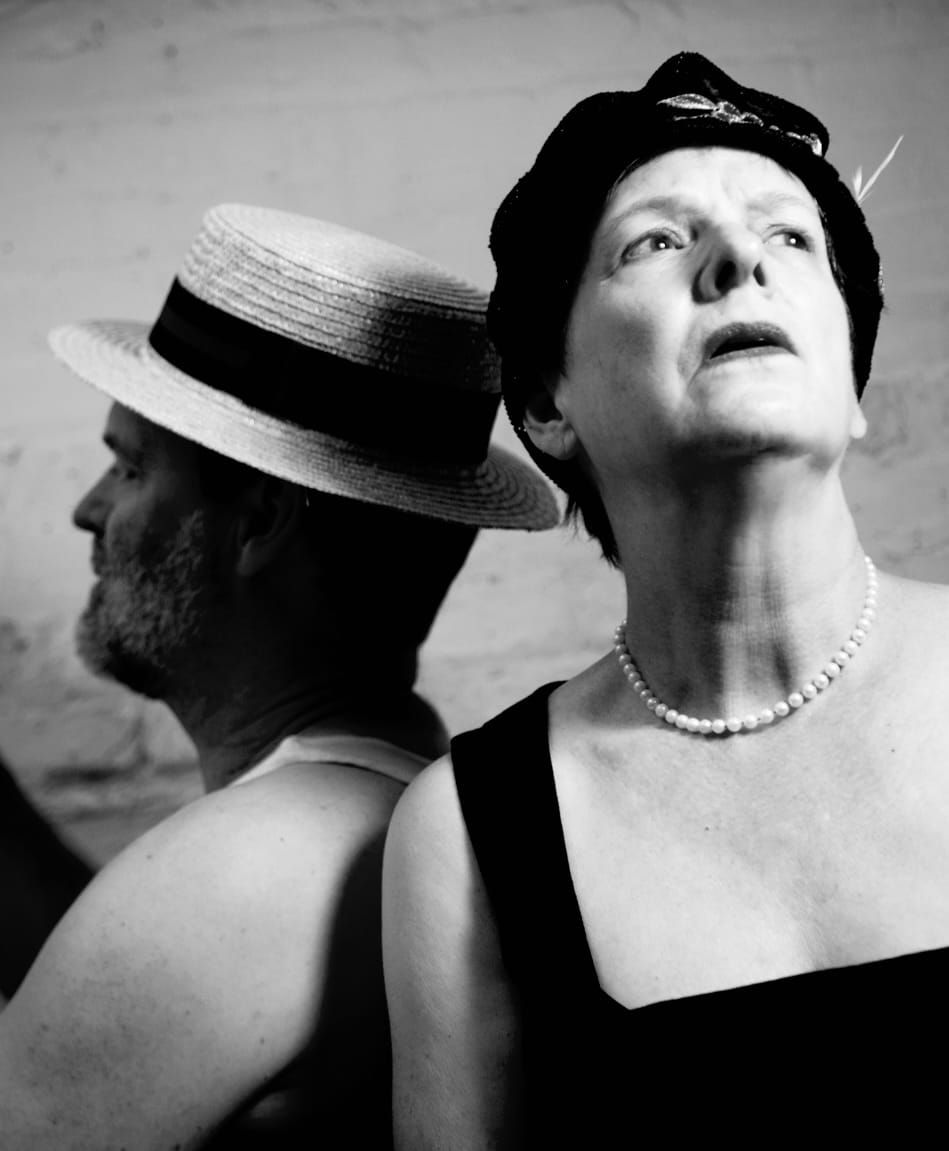
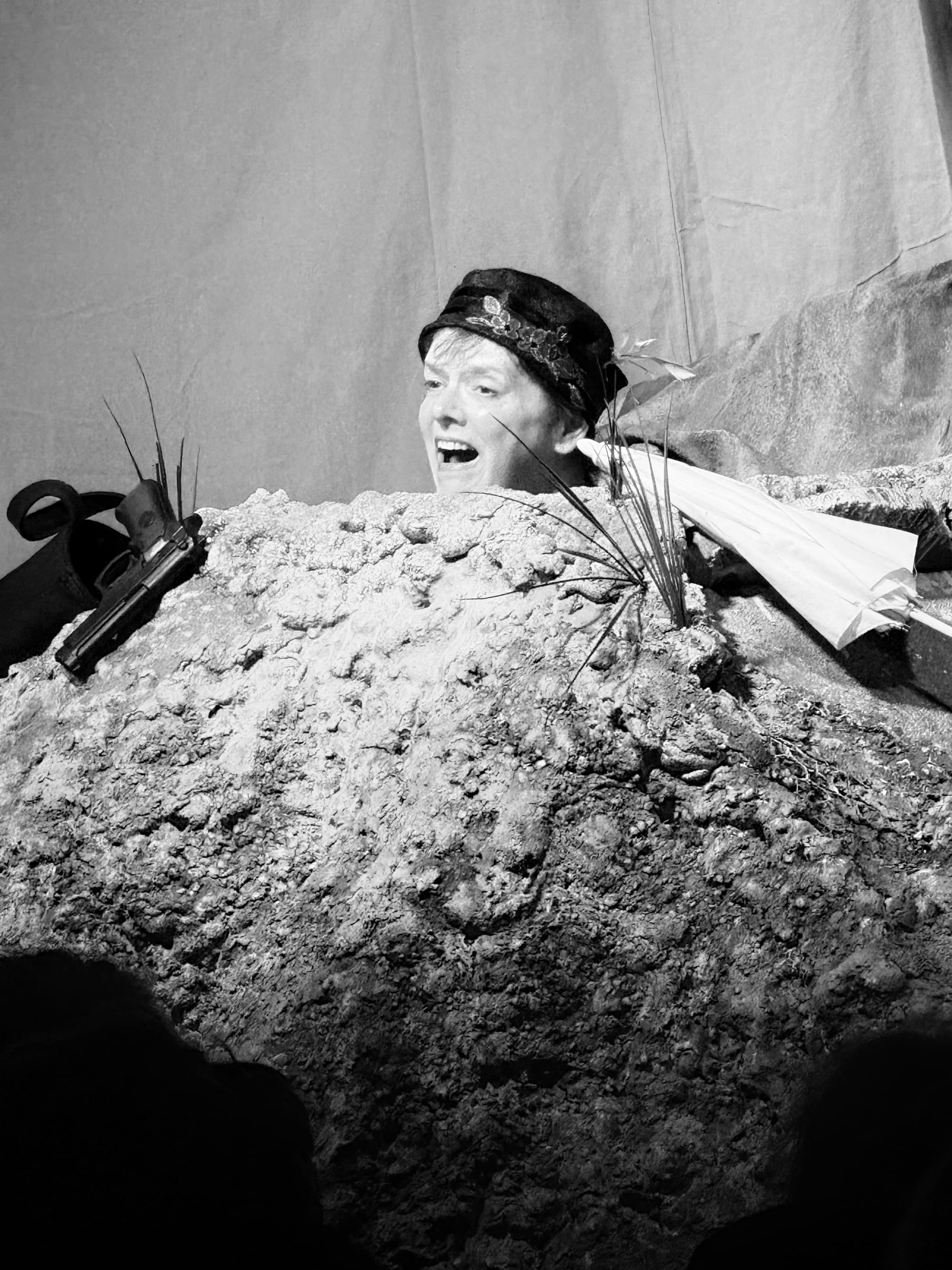
The beauty - and the trap - of Beckett is how deceptively simple his worlds are. Here, we have a giant mound of dirt (the entirety of the production's design elements are by Shokie Tseumah) our central performer, Winnie (Diana Slickman) encased within, and her husband, Willie (Ryan Walters) milling about nearby with his back turned to us for ninety-percent of his onstage time. The nature and specifics of Winnie's encasement never come to light, only that she is trapped up to her waist and, perhaps, she will be consumed even further. This does tragically come to pass by the play's second act, where Winnie is revealed to be enveloped up to her neck, with nothing to do but stare off and talk through her thoughts as the day carries on. The contents of the play are simple, too; Winnie remembers her life, remarks upon her surroundings, attempts to make small talk with her distant spouse, and otherwise twiddles her thumbs (well, until her thumbs are trapped underground) until the alarm bell signals the end of the day. Rinse, repeat.
So much theater these days (absurdist or otherwise) tends to dwell in the literal, hurling specificity at audiences who are craving imagination, to the point that any attempt to appear intelligent often comes off as facile idiocy. What a joy, then, that Beckett's worlds are almost entirely lacking in specificity, taking place in no fixed time or space, just bodies floating around magically crafted environments. In its most potent instances, this lack of specificity can create a universality of meaning and experience, successfully entertaining and inspiring audiences around the world and across time. Even that isn't enough for some, though; a certain audience member may attempt to hoist meaning onto the scenario of Happy Days ("what does this mound represent?," one may be tempted to ask), and while there are certainly schools of thought devoted to excavating what lies within the absurd, sometimes it's better not to enforce any type of imagined socio-political nature onto what can merely survive on its own as an evocative stage picture. Sometimes a mound is just a mound.
Due to the famously stringent nature of the Beckett estate, it's rare to see too much physical variation in a production of his work (though Jamie Lloyd's recent star-driven Godot on Broadway was able to get away with transplanting the action into a cylindrical behemoth), but the simple and striking nature of his physical compositions are exciting altogether. Indeed, one could imagine the choice of what material to use to construct the mound Winnie finds herself trapped in to graft some larger point onto the proceedings, be that a political flex or even a budgetary one. These exercises in finding variation within fixed circumstances are revealing ones, especially when it comes to the performances therein. Ultimately, Slickman and Walters become the two powerhouse variables of Lunsford's production, and they are both tremendous figures, entrancing in equal measure.
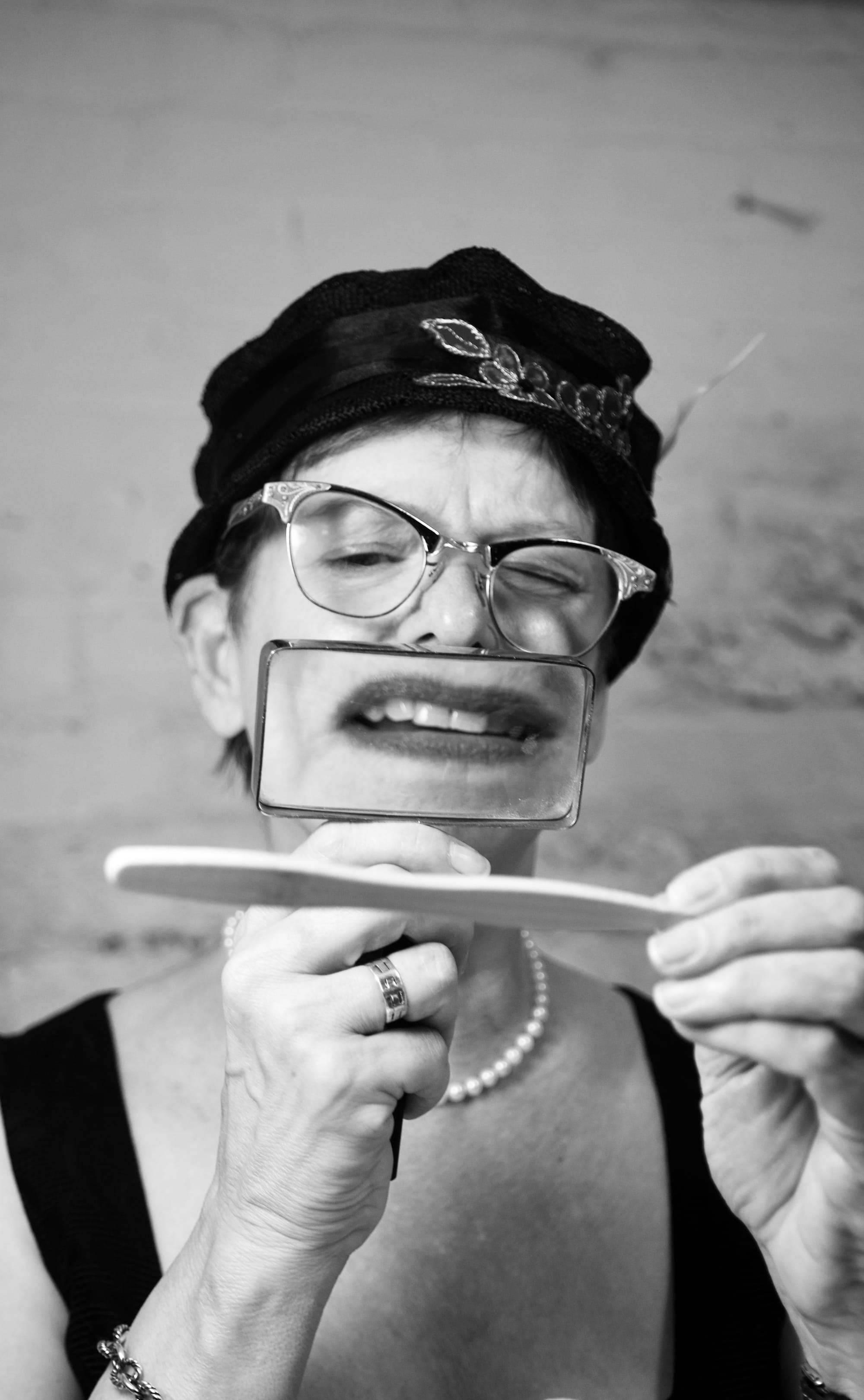
In the pivotal-but-miniature role of Willie, Walters (whose Eddie Foy in the Ruffians' Burning Bluebeard was a highlight of my early days in Chicago) provides a touch of sympathetic grace near the end of the show, but otherwise uses his gifts of clowning to perfectly follow the clockwork instructions of how this practically-silent spouse wades through the space. The show is otherwise dominated by Slickman's divine work as Winnie, a character brought to life here through joyously composed patience and focus. A seasoned performer and veteran of Chicago's Theater Oobleck, Slickman's Winnie takes the absurdity here as serious as possible, her devotion to the emotion and tragedy of Beckett's world a grand lesson in how to make bold declarations with minute, intentional choices. There's a world where Winnie is over-the-top and grandiose, overcompensating for the limitations of her station, but Slickman - relegated to the corner of the Neo-Futurist's space that likely seats no more than thirty-five - keeps herself resolute and steadfast, her eyes and gestures focused on the possibility of escaping all that's holding her down.
Happy Days is an auspicious start for Trent Lunsford and this new self-constructed home for his artistic pursuits. It's always intriguing when artists take it upon themselves to build a home for their art to be thrust into the world when the larger institutions are evidently failing to do so (the Young Jean Lee Theater Company immediately comes to mind, but local Chicago efforts like Alex Mallory and Tatiana Pavela's JunkHeart or Spencer Huffman's New Theatre Project are prime examples too), but I'm very much looking forward to what new worlds Lunsford is hoping to build. This Happy Days, then, is a perfect chance to see another of Beckett's impeccable onstage apocalypses, alongside seeing the emergence of a new directorial voice in our city. Oh, it is a happy day, indeed.
Happy Days runs an estimated 90 minutes with no intermission, and performs at The Neo-Futurist Theater (5153 N Ashland) through November 21st 2026. Tickets are available HERE.
For all press inquiries, please contact admin@benkayewords.org.