REVIEW: The Trick of Threes, with Instrumental Theatre Company.

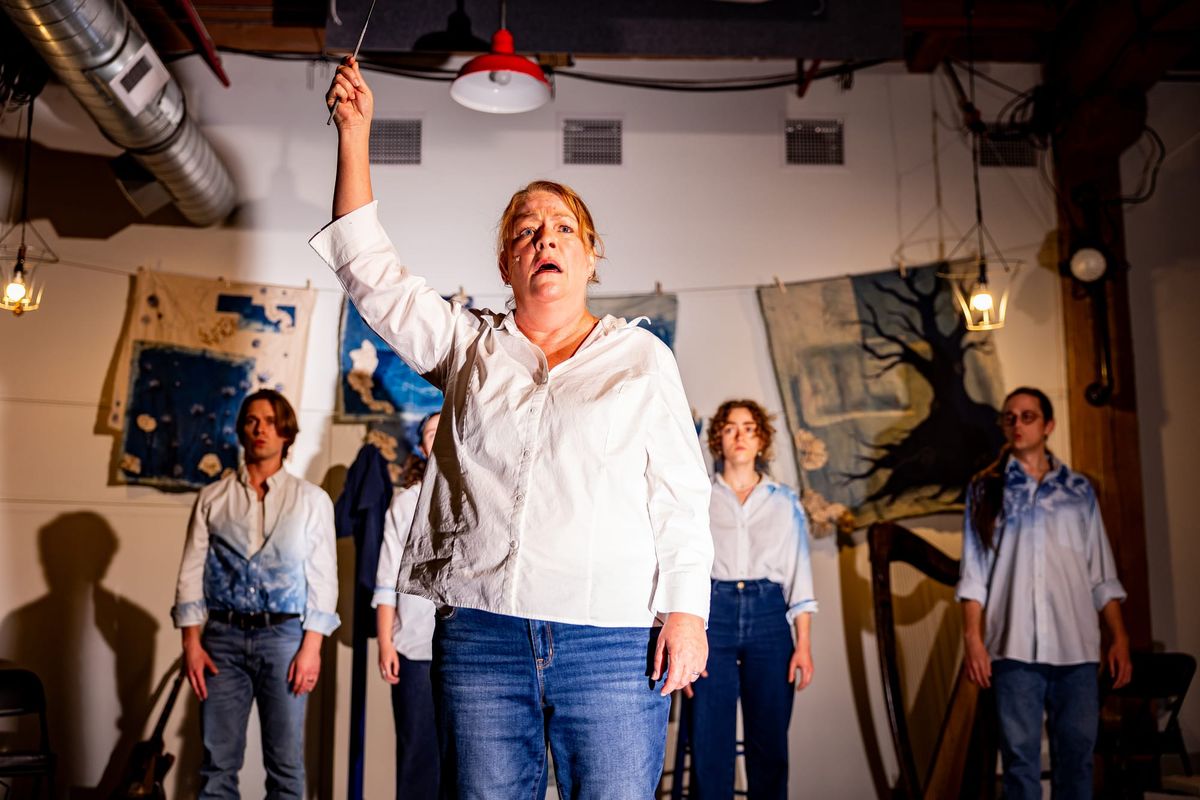
There's an incredibly tenuous relationship with the truth that's attempting to uphold Annika Andersson's The Trick of Threes, now playing in a bold and frustrating new production under the direction of Rebecca Rose Schilsky with Instrumental Theatre Company. A solo play with five performers (one actor aided by an ensemble of four actor-musicians), The Trick of Threes, both as script and staging, takes the traditionally agreed-upon tenets of trust and understanding that audiences typically bring to the theater and, in a myriad of ways, rips them apart with varying levels of success. "The first thing you should know is that everyone is lying to you," Katherine (Renae Stone) tells us in her first line of dialogue that ends up becoming the guiding principle of this production, for good and for ill.
In fact, the very framework of what this show is remains intentionally flimsy throughout; at first, you wouldn't be remiss in thinking this was some kind of mentally-fabricated motivational speech of sorts given by Katherine, who we learn early on is the survivor of a "crazy cult," the fictional Clarified Church of the Cross. Before entering the space, audience members are prompted to write questions on index cards that may or may not be answered later in the show by "the crazy cult lady," setting the stage for a show built upon audience interaction, meta-theatrics, and deep thematic exploration of what it means to becoming entangled in a cult. Andersson's script is perhaps most successful in this final regard, painting a disturbing and thought-provoking portrait of a woman whose own distant and abusive family unknowingly pushed her into the arms of a terrifying organization masquerading behind a veneer of love and acceptance.
As the evening moves along, and the musical ensemble - seemingly representing different facets of our heroine's ever fractured mind - attempts to keep the narrative plowing along in spite of Katherine's own mental destabilization, we come to realize that this whole narrative structure is actually Katherine's attempt at rehearsing an apology to her estranged daughter, Mira. The play eventually concerns itself with the ways in which we tell stories to each other, and whether we're doing ourselves - and our respective audiences - a disservice by dressing up our narratives in bells and whistles rather than facing things on as earnestly and plainly as possible. In Katherine's (and perhaps the playwright's) eyes, the truth must be faced head on, stripped of artifice and metaphor.
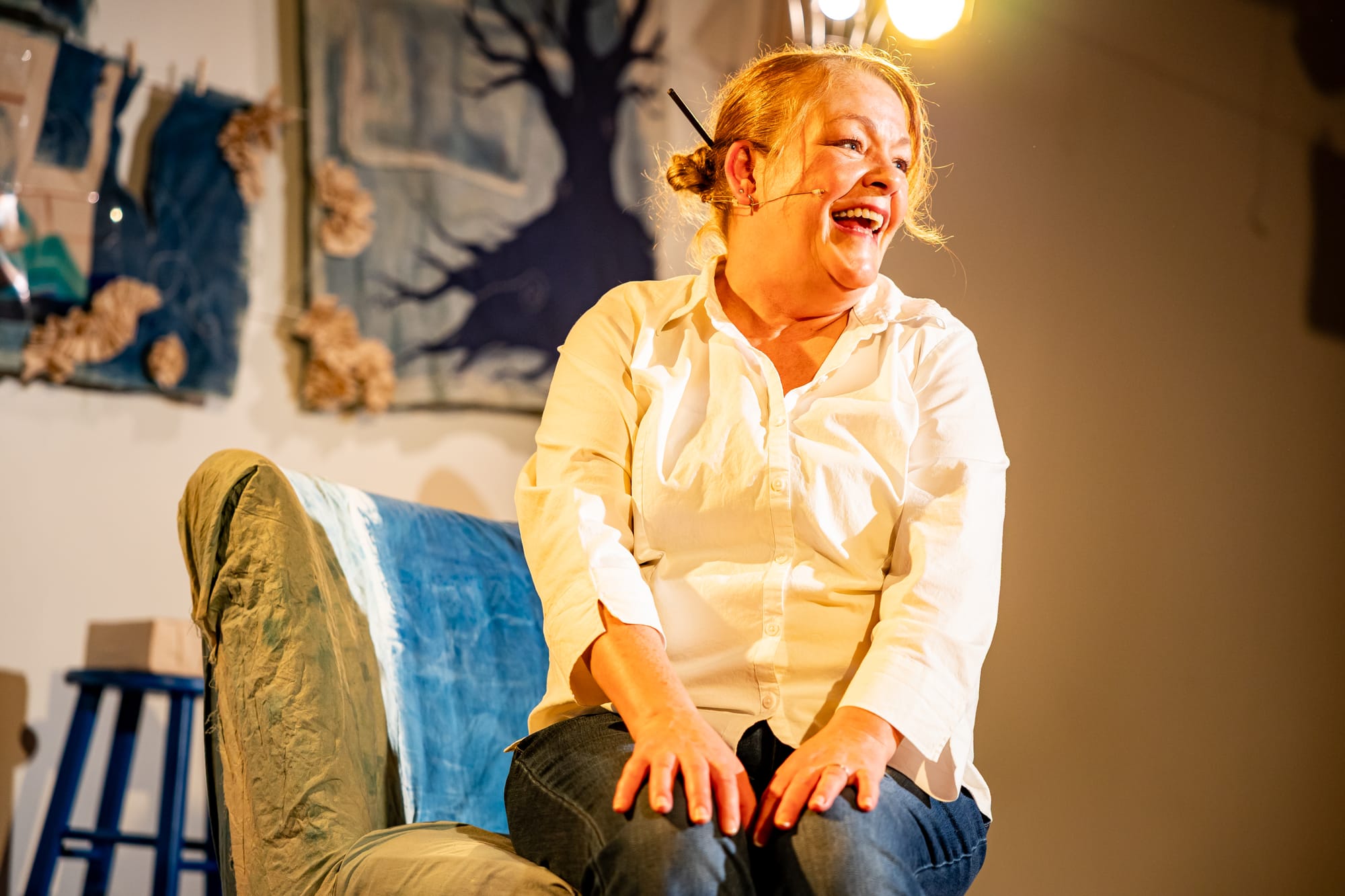
To that I say: ...to what end? There's plenty of great work out there contending with art's inherent inability to meaningfully reckon with the great tragedies of our own lives (Ross McElwee's recent film REMAKE comes to mind, alongside the haunting conclusion of Stew and Heidi Rodewald's Passing Strange), but nothing that feels so antithetical to their own construction like The Trick of Threes, a stage production whose best moments come from the suspension of disbelief and magical thinking that can only exist in the world of stage-bound performance, yet whose entire thesis as a narrative seems to be "yeah, but those moments are inherently dishonest, so what's the point?" It's a bizarre cognitive dissonance between the page and the stage that verges on the artistically trollish, presenting us with stunning music and whimsical stage pictures (Schilsky has a fantastic eye for imagery and tableau), alongside perceived moments of audience interactivity (spoiler alert; all of the index cards read aloud are planted by the production prior to the performance, so do with that what you will), only to pull the rug out from under us and tell us that we're wrong for giving in to the artistry presented therein. There's an implied contract that an audience signs when they enter a theatrical space, where we put our trust into the void and declare that we're ready for our perception of reality and storytelling to be shifted from the norm. Andersson's script presupposes "wait, who told you to trust us?"
It's a shame, because these merry means of storytelling are often quite enthralling. Katherine's band of supporting instrumentalists fill the air with evocative original music to guide the mood of the performance, while, in an attempt to build further trust, audience members are invited up on stage to reenact key moments of Katherine's life (these moments feel somewhat reminiscent of how audience members are used in Duncan Macmillan and Jonny Donahoe's Every Brilliant Thing). For the most part though, the audience interaction sadly falls flat as these moments either don't use the audience participation in any meaningful way, or the moments chosen to dramatize don't have any larger resonance within the play's overall narrative (it's unclear why we need to see Katherine race against her older brother, for example, forcing an audience member to don knee pads and run around the stage in an act of theatrical futility). Spending the entire ninety-minute runtime onstage, Stone's performance soars in the story's intimate moments, her commitment to the script's darker and more serious tone far exceeding her less-than-stable ability to handle the comedic, improvised portions of the script. Or perhaps this is an attempt to echo the message of the play, Stone making the choice not to instill any truth into the more fanciful moments of the evening.
The physical production of The Trick of Threes is also a rather exciting one; the design team of Chelsea Strebe (lights), Parrish Davis-Sauls (costumes), and Annabella Mumma (scenic and props) conjure up a haunting atmosphere for us to live in, a sea of blues and whites that are alternately harmonious and discordant. And the quartet of musicians (Jack Foley on guitar, Olivia Gregorich on harp, Brian Pember on percussion, and Carolyn Waldee on cello), under the musical direction of Am Wyckoff, provide the most enticing moments in the production, their palpable cohesion and connection as a musical unit filling the room with a gorgeous life-affirming energy. It's perhaps the most honest work being done in the room the whole evening.
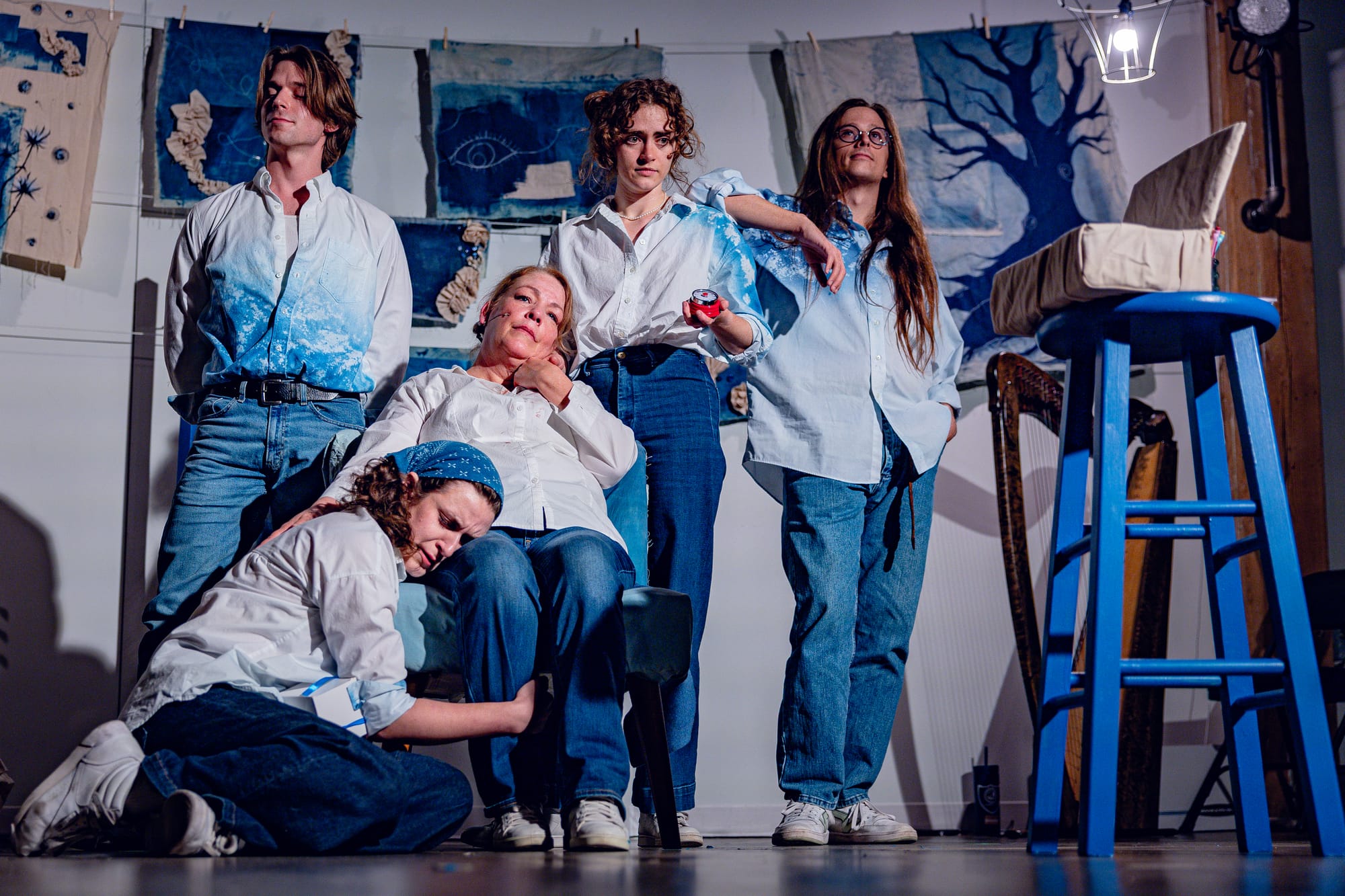
Again, then, I'm still so struck by the bewildering heel-turn of the show to end with Katherine's personal conclusion that dressing up her story in a presentation filled with music and metaphor is deceitful in itself. It feels even more bizarre for such a message of supposed musical manipulation to be housed in a show produced by a company devoted to the power of music. Instrumental Theatre Company's central ethos is that "music and theatre are essential," yet here is a show that seems to say that that isn't the case at all. It's a baffling presentation altogether, made all the more so because the message of the show isn't inherently a faulty one. Yes, we do embellish and dress up the worst moments of our lives as a means of coping with trauma and stress. Yes, truth and honesty are noble tenets that can guide us towards a better understanding and communion with one another. But none of these things are diametrically opposed to the power of music, of storytelling, of using theatrically-enhanced tools to dig at deeper truths within ourselves. If that were the case, what would even be the point of going to the theater?
At the end of the show, Katherine presents us with a new set of index cards, prompting the audience to write out how we're honestly feeling in that very moment. But by that point, such an exercise feels entirely moot. In a show built upon deceit and chicanery, upon handing us tools of understanding and then subsequently yanking them away, how can we be asked to put trust into a production that refuses to put trust in its audience? I guess the joke's on us; after all, the word trick is in the play's title.
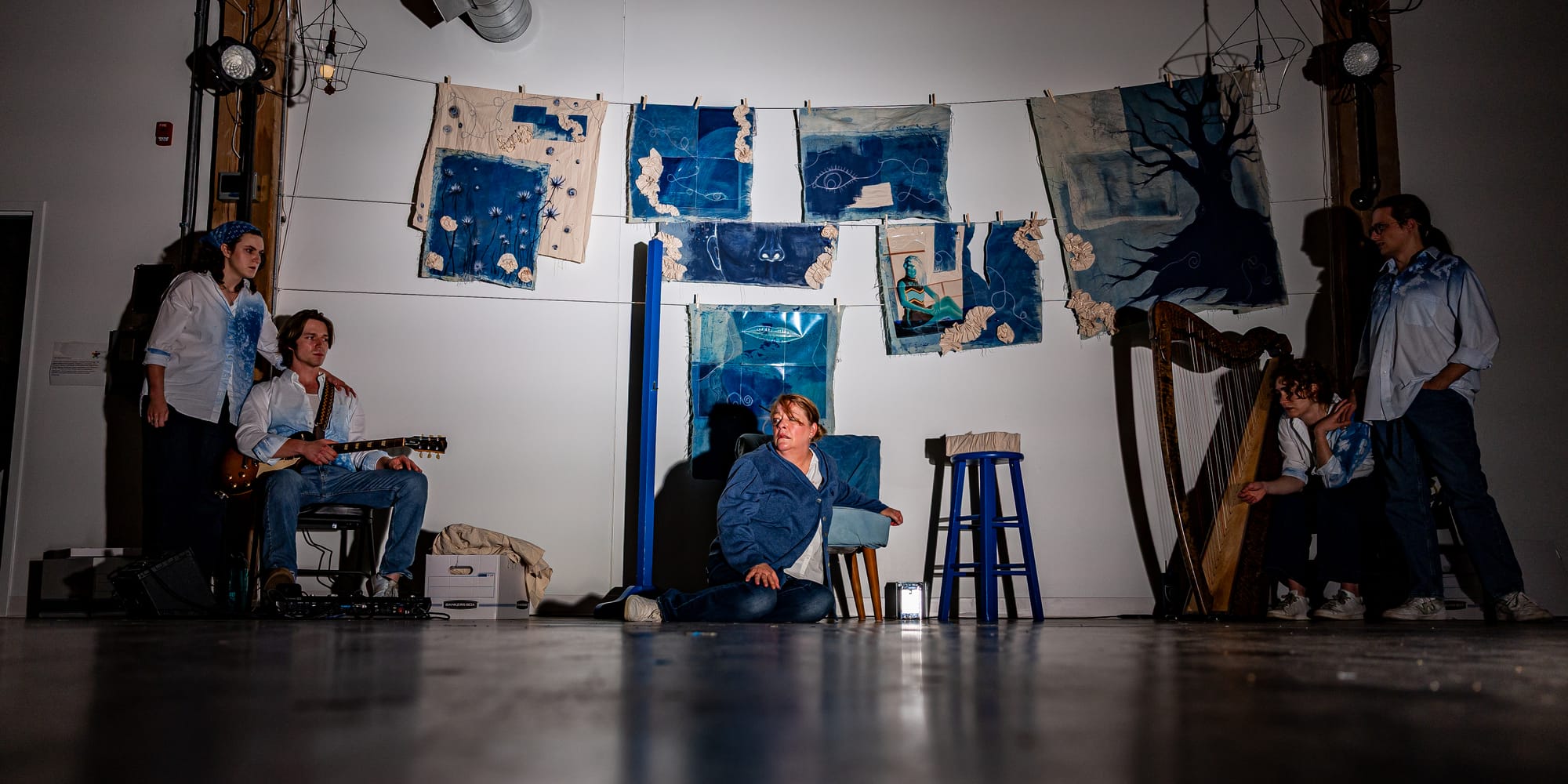
The Trick of Threes runs an estimated 90 minutes with no intermission, and performs at LFC Center for the Arts (4702 N. Ravenswood) through October 25th 2026. Tickets are available HERE.
For all press inquiries, please contact admin@benkayewords.org.