Review: Quinlyn Can Paint, with Black Cat Theatre.

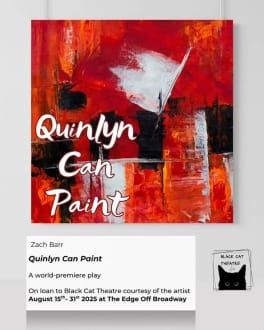
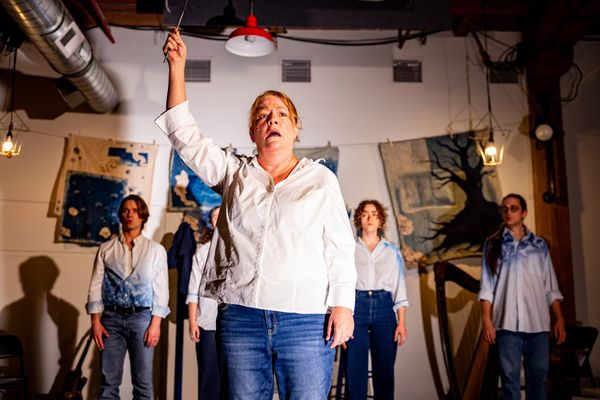
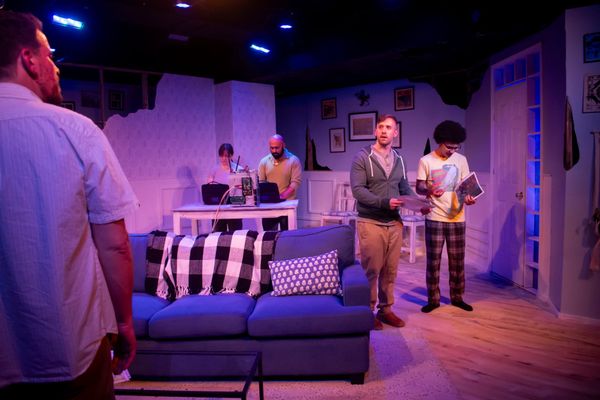
three distinct spaces exist within the frame of Quinlyn Can Paint, a new play by Zach Barr premiering with Black Cat Theatre. these are physical spaces, yes, various work and living areas designed by Anthony Doyle (scenic designer) and Kelly Jacqueline (lighting designer) to set the respective scene and tone for our triad of monologuists. but they also exist as three metaphorical canvases for Barr cast their artistic intellectualism upon, to lob arguments and dissect our world through painterly means. one of the joyful exercises of Quinlyn Can Paint is finding what unites the office with the art studio with the living room, besides a tenuous sisterly bond that permeates the theatrical space as the night goes on.
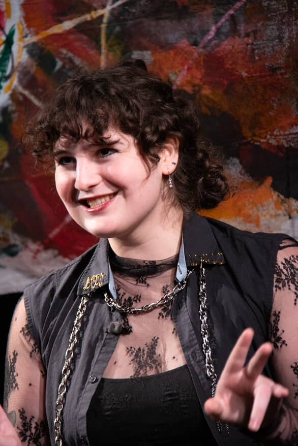
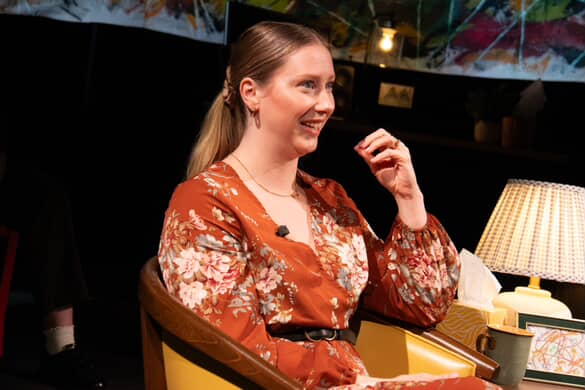
on paper, the structure of Quinlyn Can Paint is a precarious one; Barr's play exists as a series of interlocking monologues between three characters, all within the framing device of a documentary crew making a film covering the gallery exhibit of acclaimed abstract painter, Olive Hollyhox (Siah Berlatsky). the "documentary crew" highlights Olive alongside her two sisters, Quinlyn (Sheena Laird) and Gabby (Theresa Liebhart), all artists in their own right. as the title announces, Quinlyn - Olive's older sister - is also a painter, and this tension between the one sister who made it as an artist versus the one who didn't provides the dramatic core for a play with no actual "scenes."
that Barr is able to take this device and craft something that never feels repetitive or one-note, that has a genuine motor and momentum to it, is a feat in and of itself. directors Cee Scallen & Jared Sheldon are wise enough to not get in the way of Barr's script, allowing the words and the performances to be the driving forces of the evening, though one wishes there was a stronger hand to push the pace of the piece; each actor works wonders with the Herculean task of the play - no scene partners, little physical activity, a narrative that operates on a thematic timeline rather than a linear one - but with that, each is prone to languish in their respective monologues, the audience at the whims of each performer making each moment become A Moment (especially in the later, more dramatic moments of the play).
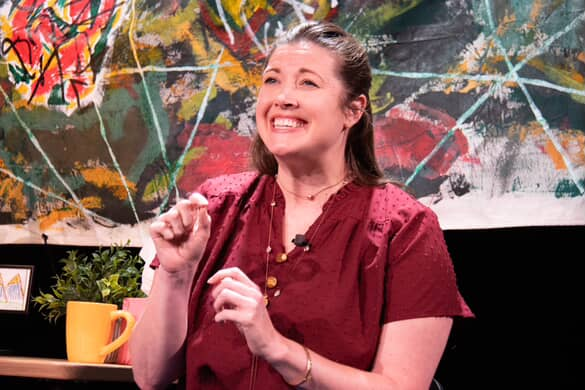
a good thing, then, that these are three excellent performers to be entrusted to here; Laird's Quinlyn is frustrating and prodding and wears bitterness like an expensive broach, her impatient gesticulations guiding us through each leg of her piteous artistic journey, but who can't empathize with the artist working a day job waiting for their big break to hit? Berlatsky plays the too-cool-for-school artist with ease, oscillating between assuredness and anxiety with aplomb. and Liebhart has some of the strongest emotional material of the evening, her bygone dreams of musical fame butting heads with the joy and pain of parenting a deaf child, culminating in a corker of a monologue delivered with wondrous emotional vulnerability.
as a playwright, Barr leads with an artistic curiosity to rival the best living writers, primarily honing in on the function of artistic narratives - and artists in general - and their role in shaping our very foundation of humanity. here, Barr neatly gloms three distinct perspectives on what it means to live as an artist onto three distinct characters; Olive exists as the artist as laborer, someone talented and/or lucky enough to be making art for a living, navigating how that role defines every facet of herself. Gabby exists as the past-tense artist, an aspiring songwriter whose teenage guitar noodling led to a one-hit wonder in the 2010's, but has all but abandoned her craft for the stability of motherhood and a teaching career.
and then there's the titular Quinlyn, resting precariously in the middle; someone with a clear passion for painting, but forever waiting on the bench to be called up to prove her mettle. creating art for art's sake, be it as a hobby or a passion project or a means of emotional expression, is certainly nothing to scoff at, but would Quinlyn agree? throughout the play, she constantly hints that her big break could come any day now. does she really believe that? is there any reality where Quinlyn believes her art can solely exist as art, even outside the frames of fame and recognition?
Gabby practically gives the game away about midway through the narrative, revealing that, in her eyes, Quinlyn does just paint for the sake of painting. she fully sees Olive in the art she creates, but "Quinlyn isn't in her paintings." how tragic, we might think, to see an artist committed to a passion that others see as passionless. but Barr invites us to view the many goals of artistic expression - painting, music, theater, anything - as fluid from artist to artist. one person's street fair painting is just as valuable as another person's fifteen-seconds-of-fame song, which is just as valuable as another person's critically acclaimed gallery piece. the three spaces are all different, and are all valid. one couldn't ask for a better conclusion from Quinlyn Can Paint, a show that is, undeniably, a play with Zach Barr written all over it.
Quinlyn Can Paint runs an estimated 100 minutes, and performs at The Edge Off Broadway (1133 W. Catalpa) through August 31st 2025. Tickets are available HERE.